Coyote in the Garden of Good and Evil:
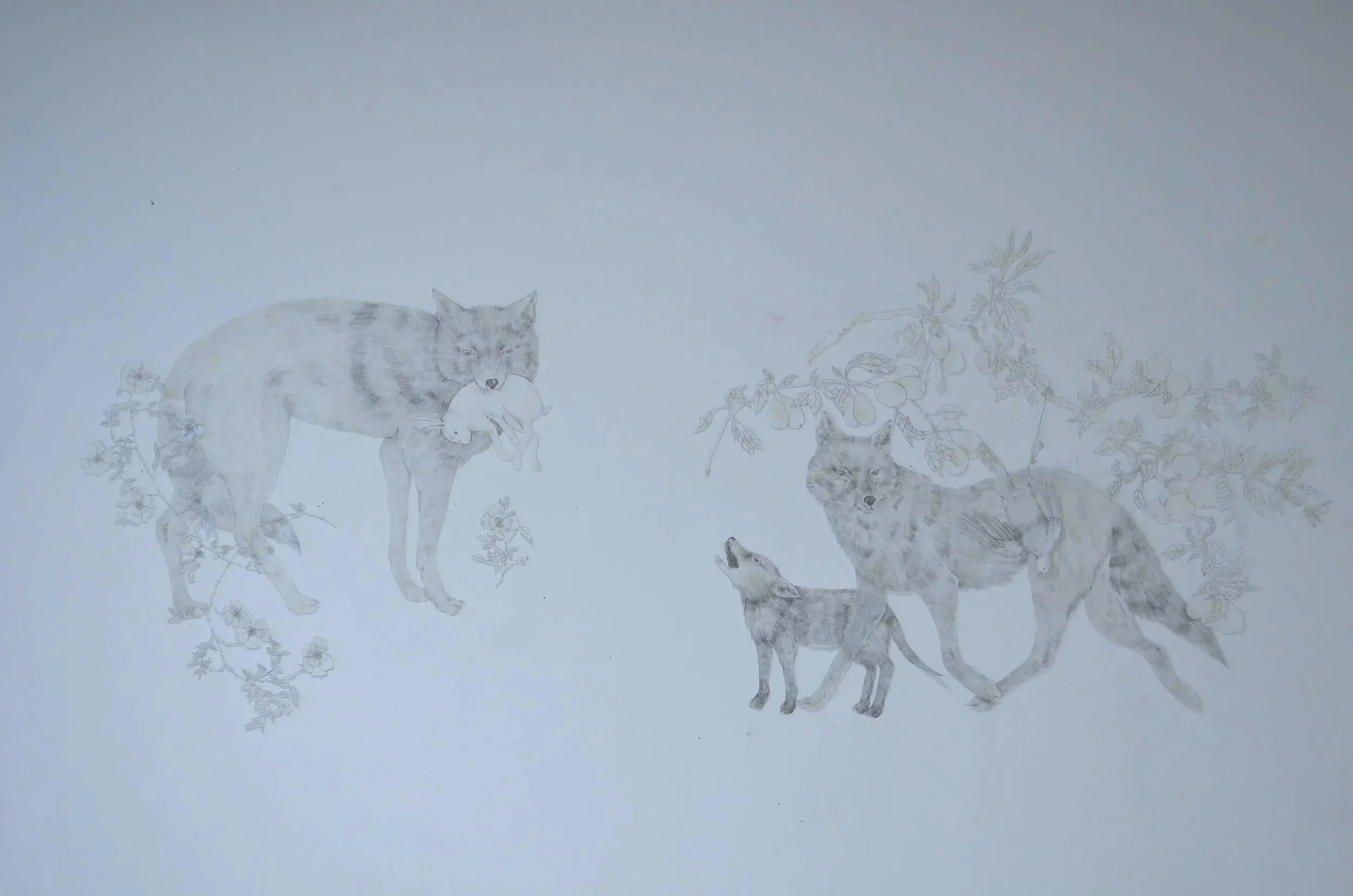
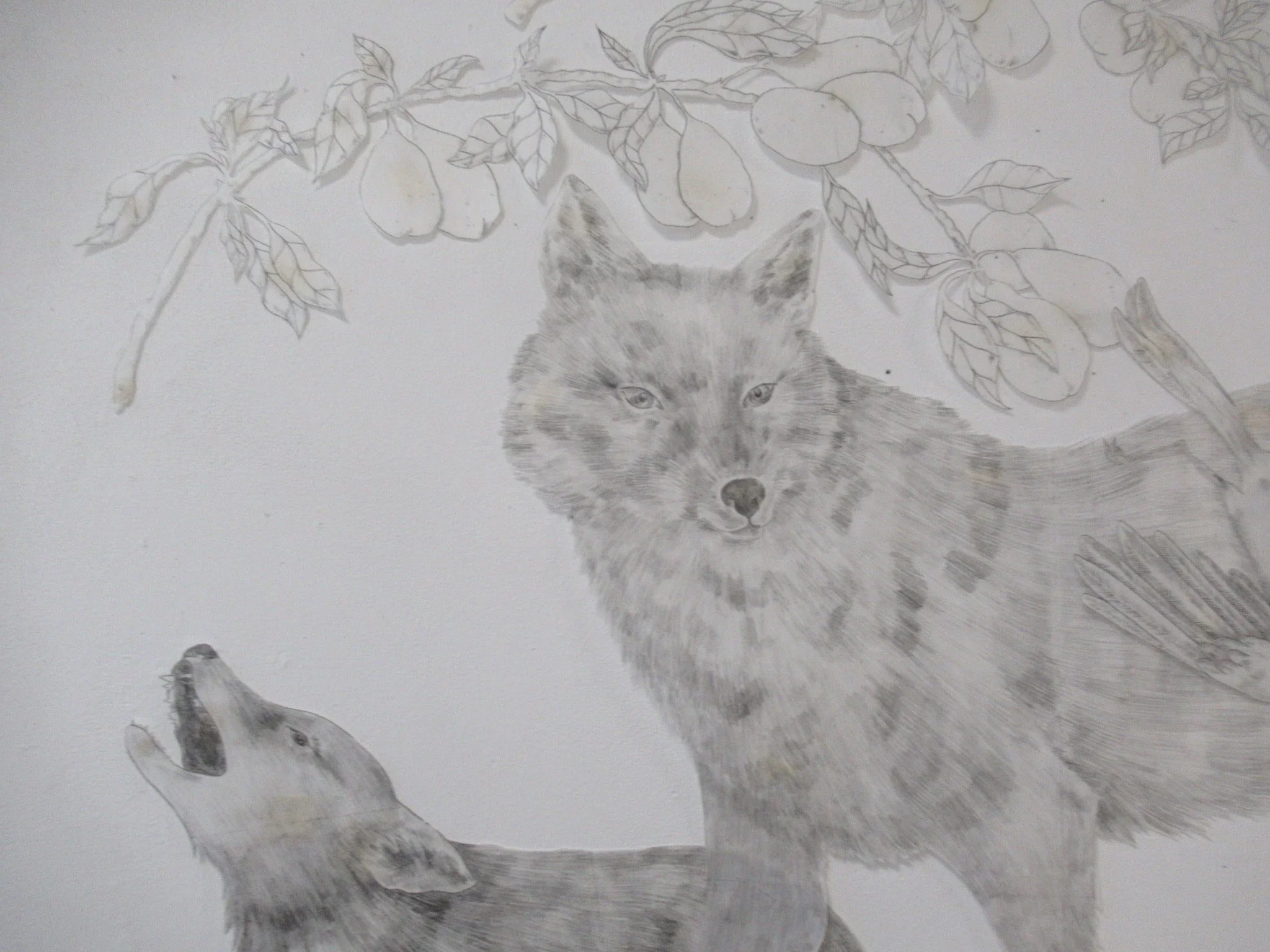
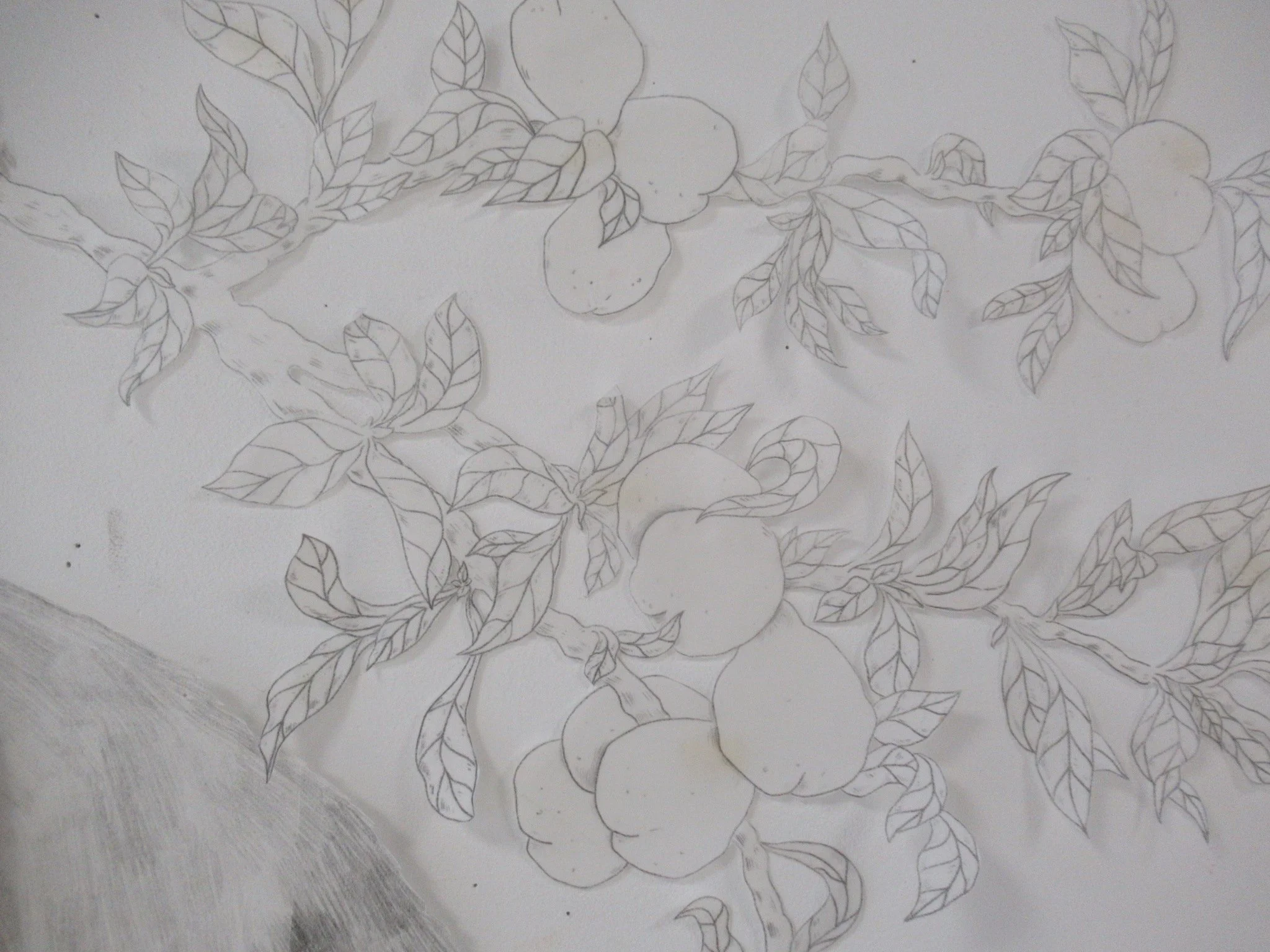
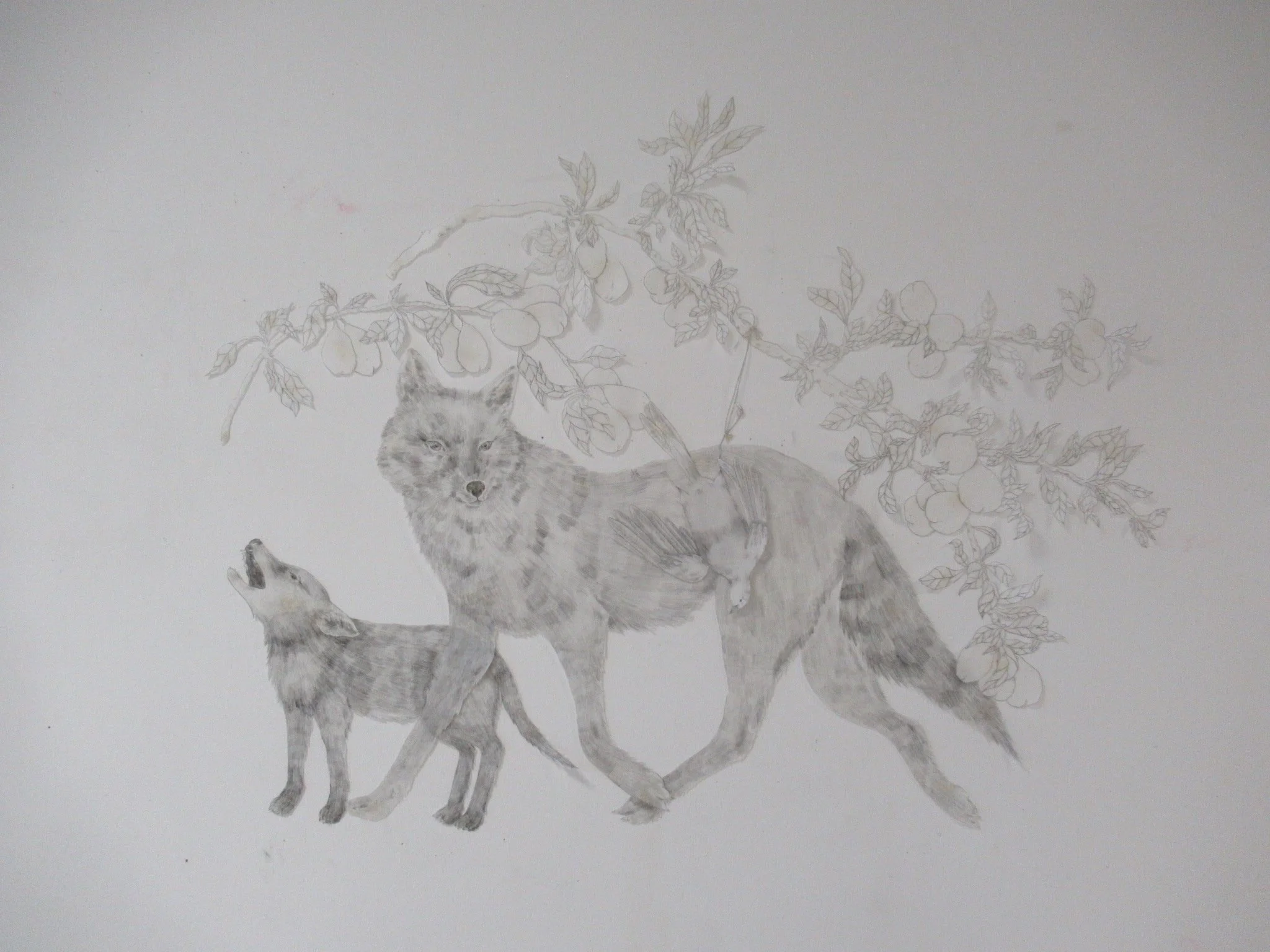
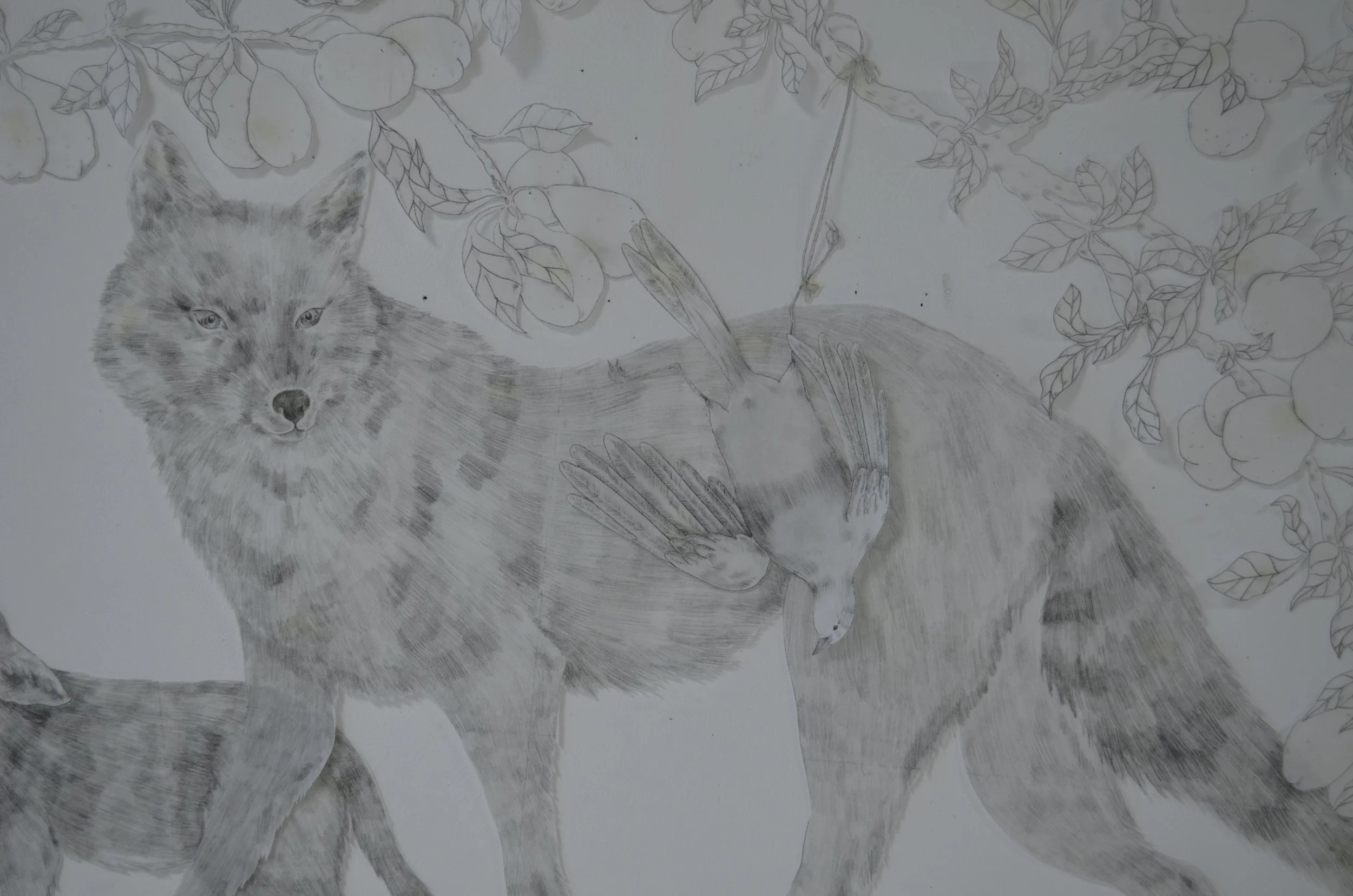
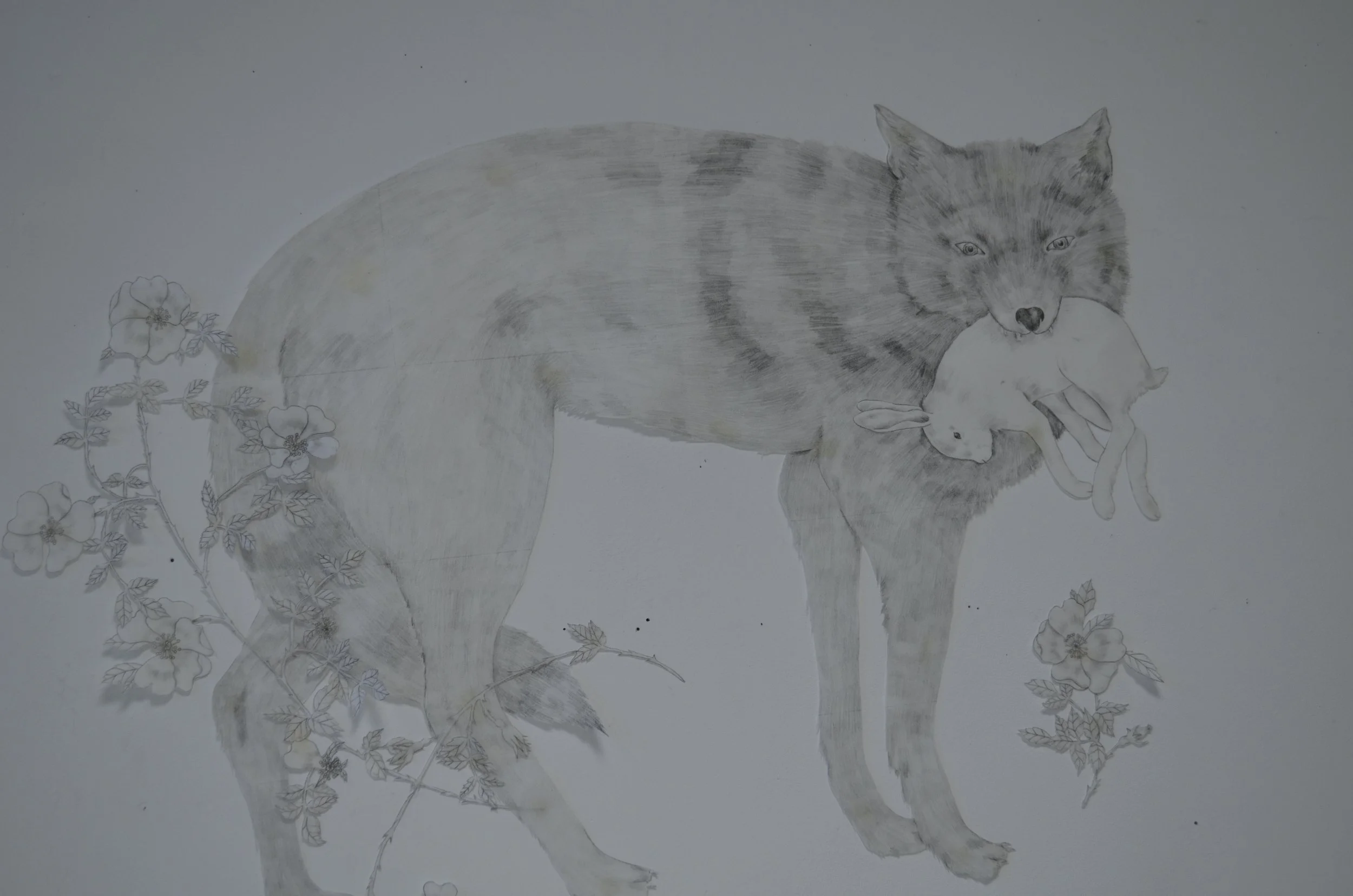
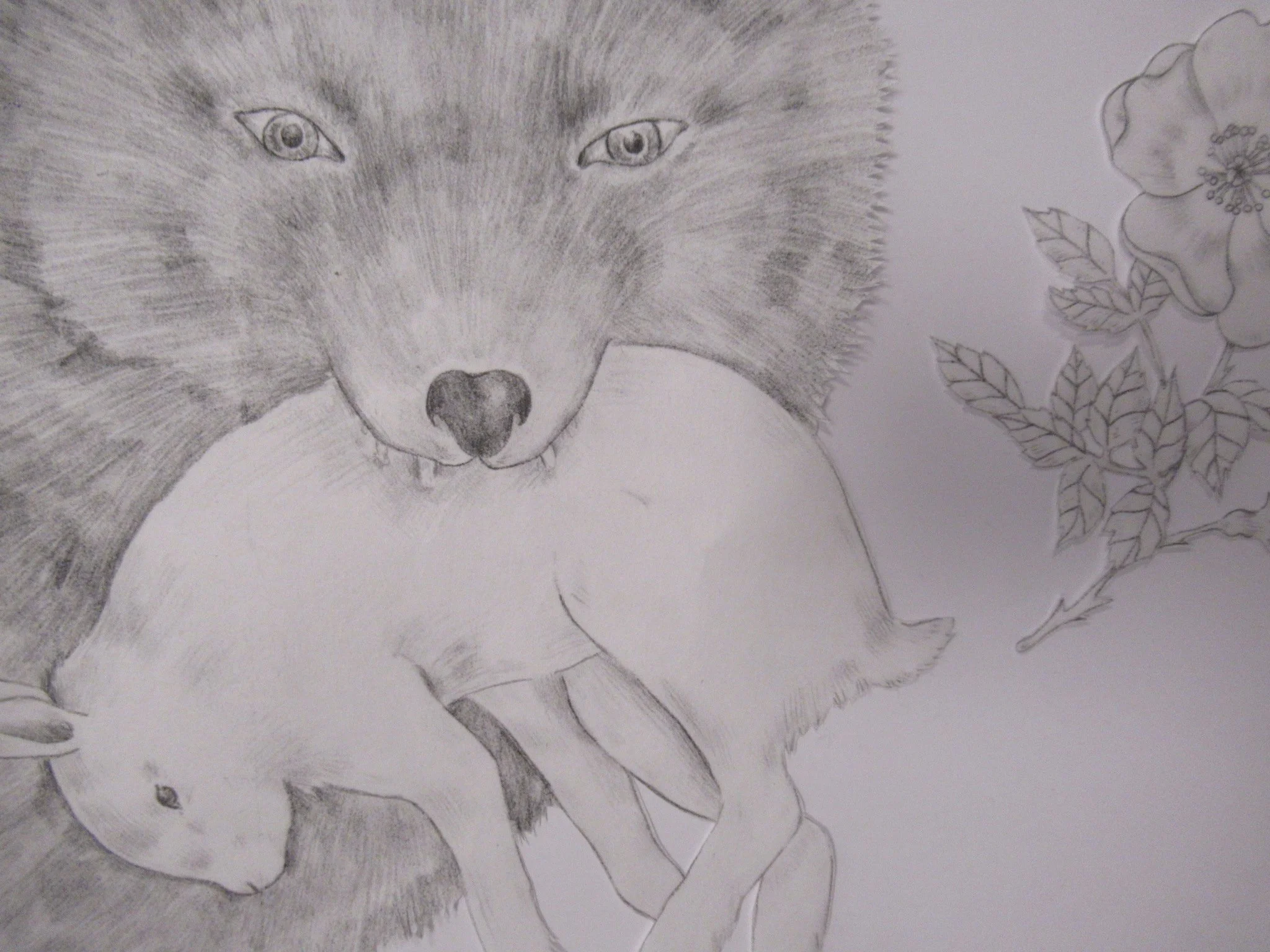
Coyote in the Garden of Good and Evil
Drawing on cut paper.
6’x13’ 2025
Statement:
Coyote in the Garden of Good and Evil, is the beginning of a work investigating folklore around animals, transformation, and in particular the Coyote. It began with an interest in examining predators and prey and the life/death cycle of this relationship. I focused on the Coyote in particular as it is Coyote who is often a feature of oral storytelling in the Southwestern United States where I grew up.
The Coyote in these stories appears sometimes as a trickster god, other times as a friend to humans, he is a creature of great cleverness, and greed. In the end of many of these stories Coyote dies, only to be inexplicably reborn in the next telling. I combined these stories with the tradition of written fables, pulling in particular on the books Fables of a Jewish Aesop, translated by Moses Hadas, and Le Roman de Renart. Pulling from the styling, morals and themes of these stories I wrote my own short story to bring Coyote to life in a way more personal to me.
The Coyote you meet here is cunning and hungry, hedonistic and full of wonder. She slips in and out of human form and makes her path on the edges of society, a master of transformation and change. She loves deeply but kills without regrets, unafraid of her own darkness. I hope you see in her a combination of both your best and worst instincts.
This work was made using carbon paper transfer to transfer initial sketches to a more realized drawing. Each drawing was then cut from the paper it began on using an x-acto knife. I was then able to play with layering the components in different ways to be installed on the wall.
Story:
It is said that Coyote was born hungry, the lone, ravenous cub of a wild and wise mother. Such a small litter is unusual and those who are more inclined towards suspicion will say that Coyote ate her siblings in the womb, hungry before she took her first breath. Such a conspiracy can never be proved one way or the other, so Coyote chooses to dismiss it entirely. They don’t need anyone else anyway - Coyote and her mother are each other's entire world.
Coyote's mother teaches her to hunt young, leaves Coyote hidden under fallen logs or foliage to watch her take down white-tailed deer and fat rabbits. The breathtaking leap an animal takes before being caught by the throat lives carved into Coyote’s heart. She thinks this is the most beautiful thing she could ever hope to see.
In the leaner months Coyote’s mother shows her which berries they can eat, and walks with her along the highway in search of roadkill. Survival is an art Coyote’s mother has learned well. They will do what they have to to survive, clinging to the edges of life with bared teeth. Coyote grows strong, a constant shadow at her mothers shoulder.
Coyotes are built to survive anywhere. They can hunt and scavenge in cool forests, jagged mountains, and endless plains. Coyote prides herself on not being picky - not a picky eater, not a picky liver - she can bloom anywhere, like the surprising plant sprouting from a cliff-face.
Coyotes are built to survive - but not for immortality. They live two years, wrapped up in each other, and then one morning Coyote's mother doesn’t wake up, still and cold with her tail tucked neatly over her nose. In all of her many forms Coyote has the capacity for grief, although without the squeamishness to fight against it, the grief is sharp, a knife at her throat. Pain - Coyote learns - can be exquisite, she has never felt so fully alive, wired with sensation tip to tail.
…
During the daytime Coyote can slip out of her shaggy pelt and move among us, by all appearances fully human. Playing human is a fascinating pastime - at once more complex and far simpler than being a coyote. Coyote thinks she was born to walk this line: all the instincts and drive of an animal, all the cunning and wonder of a human. In between here and the wild.
Coyote spends much of her life in the in-betweens, skirting the edges of open fields, sliding under the barbed wire which cannot keep her either in or out. One of her favorite spots to frequent is the neon-lit parking lot of the rundown gas station at night. Time does not exist here, people are only ever passing through, rarely does anyone notice Coyote, settled next to the ice-machine, still as she can be, paws delicately crossed. Once a kid, hair held back in two messy braids, shirt stained with something sticky and purple, brought her a donut covered in powdered sugar. Coyote thinks that eating it is like eating a cloud - soft, cool, otherworldly. Every night she spends here she quietly hopes that the child will come back, offer her more donuts, but it never happens. Instead the gas station becomes a hopeful ritual.
When she lives as a human she still loves these transient spaces - they are so alive, so constantly changing. The diner off of Route six is one of those places, it’s rare to see the same patrons eat there twice, Coyote knows this because she keeps a careful list of the scattered regulars. There’s a man who drives truckloads of lumber up and down this stretch of road - he stops by most nights around 9:30 to eat pancakes and grits. There’s a group of four high schoolers, dressed in all black, with dyed hair and a dazzling number of piercings - they come in late at night for milkshakes and french fries. There is an elderly couple who only come by on Sunday mornings to eat breakfast and spend hours on the crossword.
Finally there is the girl. The girl is not a regular. The girl works at the diner, handing out menus, setting plates of food before hungry patrons, calling everyone hon’. Coyote thinks the girl is second on the list of most the most beautiful things Coyote will ever see, almost tied for first with the image of prey suspended right before the snap of her mothers jaws. The girl smells like diner food and fresh earth, a hint of something minty. She wears big hoop earrings and ties her long curly hair up into a loose bun on the top of her head.
Coyote is an excellent observer, excellent listener, she learns that the girl lives alone in a small house on the edge of a nearby town. She learns that the people in this town think the girl is a witch - a cliched suspicion, but a fair one because the girl does indeed have a sort of magic within her. Most importantly she learns about the girl’s garden.
…
The townspeople call it the garden of good and evil, swapping stories of plants dazzling in both their beauty and their horror. They say that there are tomato bushes which sing in the direct sunlight, a tree which fruits dead rabbits, fountains which run with blood, marigolds which glow in the dark.
Coyote longs to see this garden - this place which, like her, has great capacity for both good and evil - maybe existing in such a place would settle something long gnawing at her. Would something so wonderful fill her endless hunger?
No one has ever seen this garden save for the birds which can catch a glimpse from above. The girl wears the key to the garden on a cord around her neck, she lets no one in.
When human, Coyote can be quite charming, she believes herself to be charming as a canid too, but because charm is a human concept she has no one else to confirm this. It feels as though flirting with the girl is filled with meaning. Flirting with the girl is flirting with being human, it is flirting with danger, it is flirting with her garden. Coyote cannot keep the two separate however heard she tries - she wants to devour the girl whole - she wants to lap blood from the fountain in her back yard. Coyote by this point has learned enough about being human to understand that you cannot just ask for things outright. This is true as a coyote as well: you cannot just approach a hare and ask it nicely to hop into your mouth - you have to approach the things you want slyly - don’t let them know you are coming until it is too late.
…
Coyote sits in the girl’s bed, watches her sleep, completely unaware, unfailingly trusting. She is so beautiful - Coyote imagines devouring her whole - her throat is soft, it would tear out so easily. Coyote thinks sometimes that the only way to truly know life is to hold its heartbeat in your teeth.
This is the part of the story where Coyote thinks she is supposed to have a change of heart - to realize something new about herself that stays her teeth. But this is not that sort of story, and Coyote is not a hero. She thinks as she does it that killing the girl is more intimate than fucking her was, she wonders at how lucky she is to have experienced both. Death to Coyote is divine.
When she slips the key off the cord on the girl's neck it is still warm in her palm - radiating a heat already fading from the girl's body. Coyote moves silently through the house, pads out onto the porch and moves around the side of the house, unlocks the gate. At last she is in the garden.
In her wonder Coyote forgets how to move through the in-betweens. Her mother taught her to move slowly and softly, skirt the edges, only go for the kill when the moment is right. Coyote knows the garden is dangerous, but perhaps because she is also dangerous, she feels right at home here.
Coyote doesn’t notice until it is too late the thorny tendril which snakes across the path from a previously innocuous rosebush. The rosebush knows how to be stealthy, move slowly and wait for the kill, while Coyote laps at the fountain the rosebush slowly winds its way up her leg, thorns tangling in soft fur. By the time Coyote pauses, perplexed by the sensation of the tendril tightening its hold, the thing has her. She tries to fight - Coyote is a survivor remember? She knows how to fight for her life. But as more tendrils unfurl, looping around her lovingly, the fighting isn't enough.
Watching your own death, Coyote finds, is not nearly so poetic. She can appreciate it in a removed sense, but from within it her senses are clogged by pain and fear. In the end animal and human instinct meld and telling one from the other becomes impossible. Suspended between life and death for just a moment Coyote thinks that this is the greatest in-between she has ever experienced, she wishes someone would bring her a powdered donut, and then she tips over the edge and doesn’t think anymore.